
.svg)
.svg)
.svg)
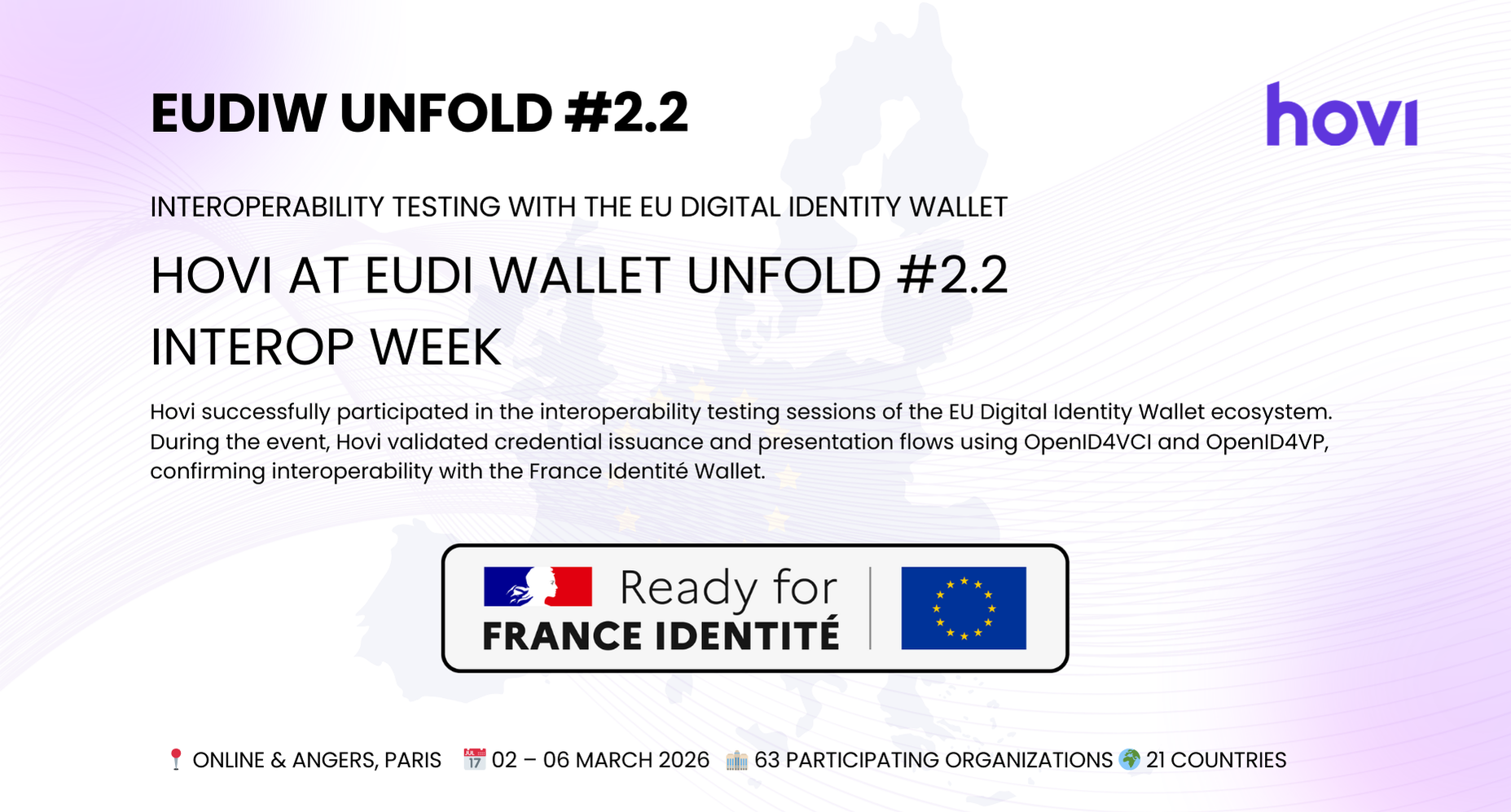
Testing real-world credential issuance and verification across the European Digital Identity ecosystem
Hovi recently reached an important milestone in its journey toward building interoperable digital identity infrastructure in Europe. During the EUDIW Unfold #2 Interop Week hosted by France Identité, our team participated in a large-scale interoperability testing event bringing together wallet providers, issuers, and verifiers from across the ecosystem. As a result of these tests, Hovi successfully achieved interoperability with the France Identité wallet and earned the official “Ready for France Identité” badge.
This Interop Week was a collaborative interoperability testing event that brought together 63 organisations from 21 countries working on the European Digital Identity Wallet ecosystem.
The goal of the interoperability week was to move beyond theoretical specifications and enable ecosystem participants to test real implementations of digital identity infrastructure across wallets, issuers, and verifiers.
Through these collaborative testing sessions, organisations validated how digital credentials can be issued, presented, and verified across independent implementations, helping accelerate the development of a truly interoperable European Digital Identity Wallet (EUDI Wallet) ecosystem.
Testing during the event covered both remote digital interactions and physical proximity scenarios, validating how wallets and verifiers interact across different environments.
Participants simulated digital credential exchanges using industry standards including:
These flows represent the foundation for secure digital identity interactions across online services.
On-site testing in Angers, France focused on real-world scenarios where credentials are exchanged face-to-face between wallets and verifiers, enabling use cases such as identity checks or license verification.
The interoperability tests focused on important digital identity credentials used across Europe:
Testing also aligned with the High Assurance Interoperability Profile (HAIP) to ensure strong security and interoperability guarantees.
The testing week demonstrated strong ecosystem collaboration:
Across these tests, participants achieved an overall success rate of 70.6%, demonstrating significant progress toward interoperable digital identity infrastructure.
The OpenID4VP 1.0 protocol emerged as the most widely tested presentation flow, with a 68% success rate across implementations.
The success of the European Digital Identity Wallet initiative depends on the ability of different wallet providers, issuers, and service providers to interoperate seamlessly.
Events such as EUDI Wallet Unfold Interop Week play a critical role in validating how standards work in practice and ensuring that the digital identity ecosystem evolves toward real-world usability and cross-border interoperability.
By participating in these collaborative testing environments, organisations like Hovi contribute to building trusted digital identity infrastructure that can operate across Europe’s digital economy.
Hovi provides infrastructure that enables organisations to issue, hold, and verify digital credentials using open standards aligned with the European Digital Identity framework.
During Interop Week, Hovi tested credential flows that demonstrate how organisations can integrate digital identity into real-world applications.
Hovi enables three core capabilities within the digital identity ecosystem:
Credential Issuance
Organisations can issue verifiable digital credentials such as identity data, licenses, or certifications using standards-based protocols.
Credential Verification
Service providers can request and verify credentials instantly, enabling trusted interactions across digital services.
The platform enables organisations to integrate digital identity capabilities aligned with the European Digital Identity Wallet ecosystem, supporting technologies such as:
Through these standards-based integrations, Hovi helps organisations build secure, interoperable digital identity solutions for the next generation of digital services.
These capabilities are built on interoperable standards designed to ensure that credentials issued in one ecosystem can be verified across others.

.svg)


