
.svg)
.svg)
.svg)
Think about the last time you had to prove who you were online. You probably uploaded a passport scan or an ID card , waited for manual review, or juggled multiple logins across different platforms. For many Europeans, this friction remains a daily reality. While some Member States such as Estonia, Germany, and the Netherlands already offer national eIDs that enable certain digital interactions, access is inconsistent, and cross-border recognition remains limited. The European Union has decided that a fragmented patchwork is no longer good enough."
The EU Digital Identity Wallet, commonly referred to as the EUDI Wallet, is the EU's answer to fragmented, insecure, and inconvenient digital identity. Built on the foundation of the eIDAS 2.0 regulation, which entered into force in May 2024, every EU Member State is now required to provide at least one wallet to its citizens, residents, and businesses by 2026. This is not a distant vision; the infrastructure is being built right now.
This guide breaks down everything you need to know about the EUDI Wallet, how it works, what it can do for you, and why 2026 is the year it becomes real.
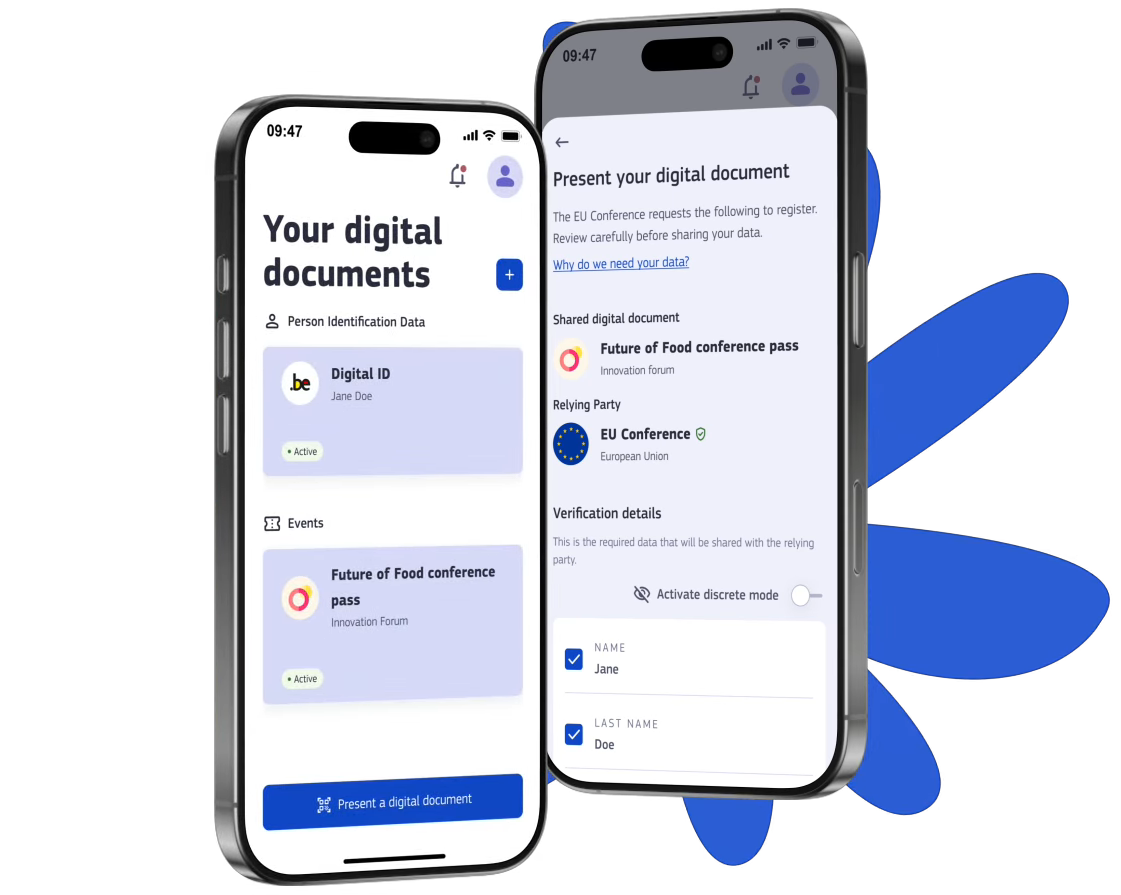
The EUDI Wallet is a secure digital platform that allows EU citizens and businesses to store, manage, and share verified identity credentials. Think of it as a digital briefcase that holds everything from your national ID and driving license to your university diploma and medical prescriptions, all in one place, legally recognized across all 27 EU Member States.
Unlike a basic document storage app, the EUDI Wallet is an active identity tool. It allows you to prove who you are, selectively share only the data a service actually needs, and sign documents digitally with full legal validity. The wallet will be entirely free of charge for users and available on mobile devices.
The legal backbone behind it all is the European Digital Identity Framework, Regulation (EU) 2024/1183, which sets the common specifications that all Member State wallets must follow. This ensures that a wallet issued in Finland works seamlessly when its holder accesses a service in Spain or Germany.
The wallet operates through a straightforward flow involving three key players: issuers, the wallet holder, and service providers.
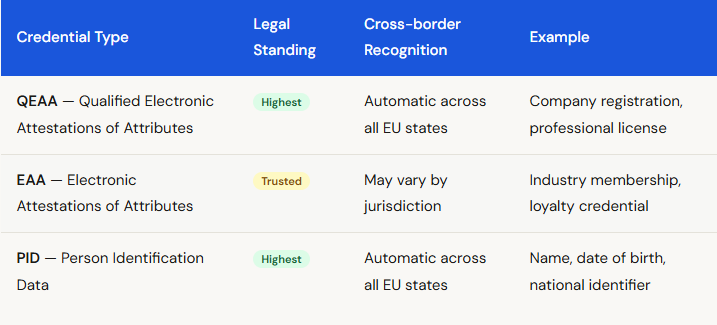
Issuers are public or private organizations that place verified credentials into your wallet. Your national government, for example, issues your Person Identification Data (PID), which is the core set of verified attributes, your name, date of birth, and unique identifier, that anchors your digital identity. Other issuers can add credentials on top of this, such as a university issuing your degree or a bank confirming your account status.
You, as the wallet holder, decide what to share and when. This is the principle of selective disclosure. If a venue needs to confirm you are over 18, your wallet can prove exactly that without revealing your full date of birth or any other personal information. You remain in control at every step.
Service providers are the organizations that request data from your wallet, whether a bank verifying your identity for account opening, a hospital accessing your medical records, or a government portal processing your tax return. The wallet generates a QR code or uses a direct connection to share only the approved data, after you confirm with your PIN or biometrics.
All of this is protected by advanced encryption,, and a built-in privacy that shows you every transaction ,All of this is underpinned by advanced encryption and multi-factor authentication. Critically, every data disclosure is logged giving you a full auditable trail of which service providers requested your data, what attributes were shared, and when. You are not just protected; you are informed."
The engine powering the EUDI Wallet is the exchange of verifiable credentials and attestations. An attestation is a digital proof of a specific fact, cryptographically signed by a trusted source.
There are two primary types:
Qualified Electronic Attestations of Attributes (QEAA) carry the highest legal standing. These are the digital equivalents of government-stamped certificates, such as your company registration or professional license, and are recognized automatically across all EU borders.
Electronic Attestations of Attributes (EAA) are trusted but may not carry the same automatic cross-border legal force. Think of a membership certificate from an industry association or a loyalty credential from a private service provider.
The entire system rests on a trust hierarchy. When you share a credential, the recipient does not simply trust you; they trust the cryptographic signature of the institution that issued it. This eliminates the need for manual verification and phone calls to third parties. Trust becomes instant and automated.
The technical specifications for all of this are documented in the EU Digital Identity Architecture and Reference Framework (ARF), now in version 2.0, published on GitHub and open for developers and organizations to build against.
The theory is compelling. The real value, however, lies in what the wallet actually changes day to day.
Under PSD2, banks and payment providers are already required to verify users through Strong Customer Authentication before processing transactions. The EUDI Wallet takes this further rather than relying on one-time codes or banking apps, a user can authenticate directly through their wallet using cryptographically verified identity credentials. This raises the security bar significantly while reducing friction for the end user. By December 2027, regulated financial institutions across the EU must accept the EUDI Wallet as a valid method for SCA.
Verifying a user's age online today typically means uploading a government ID and handing over far more personal data than the situation actually requires. The EUDI Wallet changes this through selective disclosure a user can prove they are over 18, or over 21, without revealing their name, exact date of birth, or any other attribute. For platforms selling age-restricted goods or services, this means faster, privacy-respecting compliance without the liability of storing sensitive identity documents.
Opening a bank account today involves submitting documents, waiting for manual KYC review, and sometimes visiting a branch in person. With the EUDI Wallet, a bank can verify your identity and ownership structure instantly, pulling verified data directly from your wallet. Onboarding time that currently takes days could shrink to minutes. By December 2027, regulated industries including banks are required to accept EUDI Wallets for Strong Customer Authentication.
A patient traveling within the EU will be able to share their medical records, prescriptions, and insurance details with a healthcare provider in another Member State directly from their wallet. This removes the delays and paperwork that currently make cross-border healthcare unnecessarily complicated.
Universities will be able to issue diplomas and certificates directly into student wallets. When a graduate applies for a job in another EU country, they can share their verified qualification instantly, without chasing down paper certificates or waiting for institutions to respond to verification requests.
Tax filing, social security management, permit applications, and other government interactions will all become accessible through the wallet. Citizens will no longer need to create separate accounts for each government portal or re-prove their identity every time they interact with public administration.
Boarding passes, driving licenses, and border control interactions will all be streamlined through the wallet. A single trusted identity source recognized in all Member States means less friction for people moving and working across borders.
Because this technology sits at the intersection of law, cryptography, and everyday life, misunderstandings are common. Here are the most frequent ones worth clearing up.
Myth 1: "The government will be able to see everything I do with my wallet."
Reality: Your data is stored locally on your device, not in a central government database. The wallet's privacy-by-design architecture means no single entity, including the issuing government, can track how you use your wallet or combine your transactions without your knowledge.
Myth 2: "It is just another login system."
Reality: The EUDI Wallet goes far beyond authentication. It stores legally recognized credentials, enables digital signatures, supports selective disclosure of specific attributes, and operates across borders and sectors. It is a comprehensive identity infrastructure, not a password manager.
Myth 3: "It is only relevant for individuals."
Reality: Businesses are a core part of the EUDI ecosystem. Organizations can act as issuers, placing credentials into customer wallets, or as service providers, accepting wallet-based verification for onboarding, compliance, and access management. The upcoming European Business Wallet proposal extends this logic directly to company identities.
Myth 4: "It will not be ready for years."
Reality: The regulatory framework is already in force. Large Scale Pilot projects involving hundreds of organizations across the EU have been running since 2023, testing use cases in payments, travel, education, and more. Member States are required to make wallets available to citizens by the end of 2026.
Four major consortia, funded by the European Commission, are currently building prototypes and stress-testing the EUDI Wallet across real-world use cases. These pilots bring together public agencies, private companies, universities, and technology providers from across the EU.
Two of Europe's largest economies are already in active build mode. In Germany, the Federal Agency for Breakthrough Innovations (SPRIND) is leading the national EUDI Wallet project on behalf of the Federal Ministry for Digital and State Modernization. Their approach is built around a live sandbox environment where companies and public authorities test real-world use cases from bank account opening and government portal logins to age verification and university enrollment, under realistic conditions before the public rollout. The sandbox runs in monthly cohorts, with feedback flowing directly back into the wallet's development.
In France, the national wallet effort is led by France Identité, carried by France Titres the national secure documents agency. Already live as an app, France Identité links to the citizen's physical national ID card (CNIe) via NFC and currently gives access to over 1,800 services through FranceConnect without usernames or passwords. France also coordinates the APTITUDE consortium, one of the four EU large-scale pilots, embedding its national identity infrastructure directly into the European pilot framework. Public testing of the full EUDI-compliant wallet is expected in the second half of 2026.
The use cases being tested span driving licenses, banking, government services, telecommunications, document signing, payments, travel, and organizational identities. The goal is not just to confirm the technology works but to ensure it is accessible, user-friendly, and robust enough for deployment at scale.
This active testing phase means that by the time wallets reach citizens in 2026, the underlying infrastructure will have been validated by real users across multiple countries and sectors.
At Hovi, we work directly with organizations navigating this transition. The standards are set. The timeline is firm. The work of getting ready starts now.
At Unfold #3 in Paris, we showcased live demos of real-world EUDI Wallet use cases from age verification and healthcare identity to AI agents interacting with verified credentials. Watch the demo →=
The regulatory milestones are clear and binding:
By the end of 2026, every EU Member State must provide at least one EUDI Wallet to its citizens, residents, and businesses, built to the common technical specifications set out in the Architecture and Reference Framework.
By December 2027, regulated industries, including banks, financial institutions, and other sectors covered by EU law, must accept the EUDI Wallet for Strong Customer Authentication.
For businesses and organizations, this timeline is not just background noise. It defines the window in which you need to understand the ecosystem, assess your role within it, whether as an issuer, a verifier, or both, and build or integrate the necessary infrastructure.
The EUDI Wallet represents a fundamental shift in how identity works in Europe. Moving from physical documents and siloed digital accounts to cryptographically verified, user-controlled credentials changes the economics of trust. Verification becomes cheaper, faster, and more reliable. Fraud becomes harder. Cross-border interactions become routine rather than painful.
For businesses operating in regulated industries, the question is no longer whether the EUDI Wallet will affect your operations. It is how prepared you will be when it does.
At Hovi, we work directly with organizations navigating this transition. Whether you are a financial institution preparing for EUDI-compliant onboarding, a service provider looking to accept verifiable credentials, or an organization that wants to issue credentials into customer wallets, our infrastructure is built to make that integration straightforward. The standards are set. The timeline is firm. The work of getting ready starts now.

.svg)


