
.svg)
.svg)
.svg)
.jpg)
Every time you prove who you are online, you hand over far more than the situation demands. Signing up for a new financial service, you upload a passport. Accessing a government portal, you submit documents containing your address, your photo, your date of birth, and everything in between. The platform needed to confirm one thing. You gave it everything, again.
This is not just friction. It is the mechanism by which your personal data ends up scattered across dozens of databases you did not choose, held by parties you do not control, exposed in breaches you could not prevent. Each verification transaction chips away at your ownership of your own identity, one unnecessary disclosure at a time.
Self-Sovereign Identity is the model that changes this. It is one of the foundational principles driving the shift from centralized identity infrastructure toward a world where individuals genuinely own and control their digital identities. In 2026, as the EU Digital Identity Wallet moves into widespread deployment and digital credential ecosystems mature globally, SSI is transitioning from a technical movement into everyday infrastructure. This guide explains what it is, how it works, and why it matters for anyone operating in the digital identity space.
Self-Sovereign Identity (SSI) is a model that gives individuals full ownership and control of their digital identities without relying on a third party. In contrast to centralized identity management, you are the boss of your identity and get to decide who gets to see your data. You can also remove access to your data at any time.
A practical example makes this concrete. Imagine a job applicant who holds a digitally issued First Aid certificate in her identity wallet. An employer asks her to prove that the certificate is valid and current. With SSI, she can share exactly that the certificate number and her name without the employer ever seeing her email address, home address, or any other detail she did not choose to disclose. The credential is cryptographically authentic. The proof is instant. But she controlled precisely what was shared.
There are three main participants in the SSI system: the Holder, who creates a decentralized identifier with a digital wallet and receives Verifiable Credentials; the Issuer, a party with the authority to issue those credentials; and the Verifier, the party checking the credential. The interactions between these three parties is sometimes called the trust triangle. Every time information is requested by a verifier, the holder chooses whether to allow access to their data.
This is what makes SSI fundamentally different from how identity works today. Traditional identity works like a giant library run by someone else. You hand over your details, they file everything, and you depend on them to access it. SSI is completely different. You hold the vault. You carry the keys. You decide what gets shared, when, and with whom. The credential issuer signs the data cryptographically. The holder then presents only what is needed. The verifier confirms authenticity without ever receiving more than the transaction required.
SSI rests on three technical pillars that work together: blockchain, Decentralized Identifiers, and Verifiable Credentials. Before diving into each, it helps to understand the trust framework that connects them commonly referred to as the Trust Triangle.
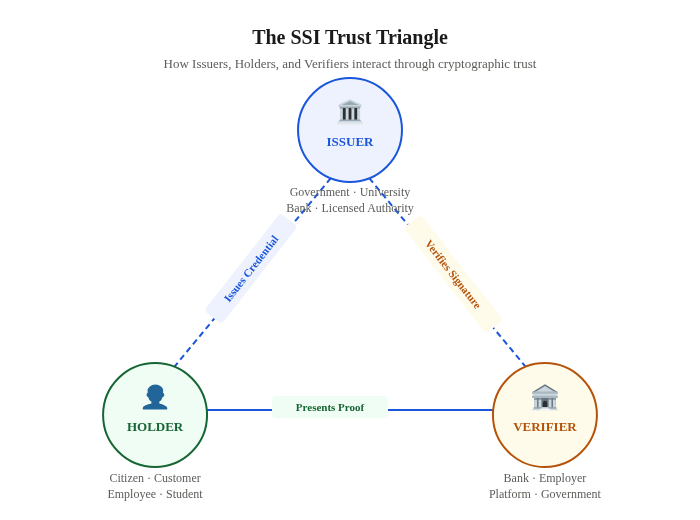
The Trust Triangle describes the three-party relationship at the heart of every SSI interaction. The Issuer is a trusted authority a government, university, or licensed institution that issues a verified credential to the Holder. The Holder stores that credential in their digital wallet and decides when and with whom to share it. The Verifier is the organization or service requesting proof of a specific attribute. Crucially, the Verifier does not need to contact the Issuer directly to confirm the credential is valid the cryptographic signature does that automatically. Trust flows between all three parties through mathematics, not through phone calls, manual checks, or bilateral agreements.
Blockchain is a decentralized database shared among computers in a network that records information in a way that makes it very difficult to change, hack, or cheat the system. Each block has unique data about the previous block, and once data is verified, it is added to the blockchain permanently. In the SSI context, the blockchain does not store identity data itself. It stores the public Decentralized Identifiers of issuers and holders, providing a shared source of truth about which credentials are valid and who authenticated the data inside them.
Decentralized Identifiers (DIDs) allow people to create digital identities that they can securely connect to their Verifiable Credentials without revealing personal information without authorization. A DID is a globally unique identifier made up of a string of letters and numbers that is independent of any organization. A person can hold multiple DIDs for different contexts — one for professional credentials, another for financial services, another for personal use making it structurally harder to track or correlate their activity across platforms.
Verifiable Credentials are digital, cryptographically-secured versions of paper and digital credentials that people can present to parties that need them for verification. When digital credentials conform to the W3C Verifiable Credentials Data Model standards, they can be verified instantly without needing to contact the issuing organization.
Two additional technologies extend what SSI can do for privacy. Selective disclosure allows a holder to reveal only specific attributes from a credential without exposing the rest. Zero-knowledge proofs go further still: with zero-knowledge proof technology, SSI providers help people maintain privacy by proving a condition is met such as being over 18 without even revealing the underlying date of birth. The holder can show the verifier that they meet a requirement without needing to show the data that supports that proof.
The practical delivery mechanism behind all of these benefits is the identity wallet. An identity wallet is a secure application typically on a mobile device that stores your verified credentials, manages your decentralized identifiers, and handles the cryptographic processes involved in presenting proofs to verifiers. It is the interface between you and the SSI ecosystem. Rather than carrying physical documents or relying on a third-party platform to hold your identity data, the wallet puts everything in your hands literally. Your national ID, driving licence, university diploma, health insurance details, professional licences, and age verification credentials all live in one place, encrypted on your device. When a service requests proof of a specific attribute, the wallet generates a cryptographic proof and presents only what was asked for. Nothing more leaves your device unless you explicitly approve it. The wallet does not just store identity, it actively manages how your identity is shared, revoked, and audited across every interaction you have with a transaction log visible only to you, not to the issuers or verifiers involved.
Full ownership and control of personal data. SSI technology allows people to self-manage their digital identities without depending on third-party providers to store and manage the data. This is a structural shift from the current default, where identity data is owned by whichever platform issued or verified it, not by the individual it belongs to.
Dramatically reduced breach exposure. According to Verizon's Data Breach Investigations Report, the large majority of hacking-related breaches have historically involved brute force attacks or the use of lost or stolen credentials. Data stored on an issuer's centralized servers carries an increased risk of becoming a target for hacks, breaches, or leaks. SSI removes the central honeypot. When personal data is stored in a holder's own wallet rather than on institutional servers, there is no single point of failure to attack.
Faster and cheaper verification for organizations. Organizations can significantly reduce costs, inefficiencies, and resources by verifying credentials like nurse licenses or online course completion certificates instantly instead of waiting days, weeks, or months. Early SSI deployments in banking and financial services point toward meaningfully faster KYC processes, with less paperwork, less waiting, and fewer identity middlemen.
Privacy that matches the context. With SSI, individuals can calibrate what they share to exactly what a situation requires. People do not have to provide unnecessary and excessive information beyond what is requested like showing a full address when all that is needed is to confirm an age. Each interaction involves a deliberate, informed consent decision rather than an all-or-nothing document submission.
Financial inclusion and portability. SSI wallets are mobile-first and biometric-enabled, which is significant given that, according to the World Bank's Global Findex Database, hundreds of millions of people worldwide remain unbanked and rely on mobile phones as their primary point of access to digital services. A verifiable digital identity that travels with the holder across borders and platforms removes one of the most persistent barriers to financial and social participation.
Lower regulatory and operational burden for businesses. Collecting less data means storing less data, which means less exposure to data protection liability, lower storage costs, and reduced compliance complexity particularly for organizations operating across multiple jurisdictions with differing data retention requirements.
KYC and AML compliance requires financial institutions to confirm identity and eligibility, but it does not require them to hold copies of every document a customer has ever submitted. With SSI, a bank can receive a cryptographic proof that identity has been verified by a trusted authority and that the customer meets required thresholds without receiving or storing the underlying documents. Instead of doing a different KYC process for every service, holders can reuse their KYC credentials: if Company A ran a KYC check and issued Verifiable Credentials, those same credentials can be reused when signing up for Company B to speed up the process.
In order to provide efficient and consistent service based on accurate information on a patient's identity and medical history, SSI can help maintain an accurate record that can be shared efficiently with relevant healthcare providers. A patient seeking treatment in a different country can share only the relevant records vaccination history, current prescriptions, insurance status without exposing their full medical history to every new provider. In Finland, the MyData initiative is a government-backed model giving citizens greater control over how their personal data, including health information, is accessed and shared across services, reflecting the same consent-based approach that underpins SSI.
Organizations that want to recruit high-quality candidates efficiently can verify educational and professional credentials like a university degree and professional certificates instantly with SSI, saving days to weeks compared to traditional manual verification processes. A job applicant can confirm the validity of a qualification without sharing their student number, module grades, or any other details from their academic record that the employer did not ask for. The credential is real. The proof is instant. The oversharing that currently defines document-based hiring is eliminated.
Buenos Aires is leading the charge with its miBA app, now used by more than 3.6 million residents, who use it to access government documents, permits, and city services through a decentralized digital identity, no queues, no paper. Citizens accessing public services or applying for benefits can prove eligibility for a specific service without submitting a full identity record each time, with each interaction releasing only the attributes that service actually requires.
Instead of pulling out an entire wallet driver's license, credit cards just to prove age, a person can tap their phone and share one single fact: proof that they are over the required threshold. No address. No ID number. For any service requiring a binary confirmation age, license status, membership SSI replaces full document submission with a simple, privacy-preserving proof. The service receives the answer it needs. The user retains everything else.
The EU Digital Identity Wallet brings SSI principles to population scale for the first time. Every EU Member State is required to make at least one compliant wallet available to citizens by end of 2026, and the wallet architecture mandates selective disclosure and Verifiable Credential support across all credential formats. This means SSI will become a standard expectation of the verification experience across Europe not a specialist feature but a baseline.
The concept has been evolving since 2016, but 2026 is the breakthrough year, driven by mature blockchain infrastructure and stronger digital ID regulations like eIDAS 2.0. For businesses operating as relying parties those requesting and verifying wallet credentials this creates both an obligation and an opportunity. The obligation is to redesign verification flows around minimum necessary attributes. The opportunity is to build onboarding and identity experiences that are faster, cheaper, and trusted by the users going through them.
Myth 1: "SSI is too complex for everyday users." The complexity is in the cryptographic layer, not in the experience. From a user's perspective, they download a wallet, receive a credential, and tap to share what they choose. Modern SSI wallets are mobile-first, biometric-enabled, and designed to be straightforward to use. The mathematics is abstracted away entirely by wallet and platform infrastructure.
Myth 2: "If someone shares only part of a credential, the proof cannot be trusted." Partial disclosure does not weaken verification it is designed to work precisely this way. The cryptographic signature from the issuing authority covers the attributes that were shared. Sharing a subset of a credential does not alter the validity of the proof for those specific attributes.
Myth 3: "SSI cannot meet compliance requirements like KYC." Regulatory requirements specify which facts need to be confirmed, not how much surrounding data must be collected in the process. Verifiable Credentials allow verifiers to verify credentials in seconds while meeting data compliance regulations confirming what compliance frameworks actually require without collecting data those frameworks do not demand.
Myth 4: "This is only relevant for individual consumers." SSI applies equally to organizational identity. A company can prove its registration status, tax compliance, or professional certification by sharing exactly the attributes a counterparty requires, without exposing its full corporate structure. The European Business Wallet extends these same principles directly into B2B contexts.
SSI is not a concept that businesses can defer engaging with. Adoption of SSI is still in its early stages relative to its long-term potential, but that window is closing rapidly. The regulatory framework is already in place, the technical standards are finalized, and the wallets are being deployed now.
For businesses, the practical work involves auditing current data collection practices against what each transaction actually requires, rebuilding verification flows around specific attributes rather than full document submission, and ensuring technical infrastructure is compatible with EUDIW credential formats. The organizations that build their identity infrastructure around SSI principles now will be best positioned when deployment reaches scale and the deadline is no longer years away.
At Hovi, SSI is foundational to how we have built our credential infrastructure. We work with organizations issuing Verifiable Credentials that give their users genuine control over their data, and with businesses that need to verify specific attributes from wallet-based credentials without collecting more than a transaction requires. The direction is clear. The timeline is set. The question is not whether to build for this world, but how ready you are when it arrives.
At Unfold #3 in Paris, we showcased live demos of real-world EUDI Wallet use cases — from age verification and healthcare identity to AI agents interacting with verified credentials.

.svg)


